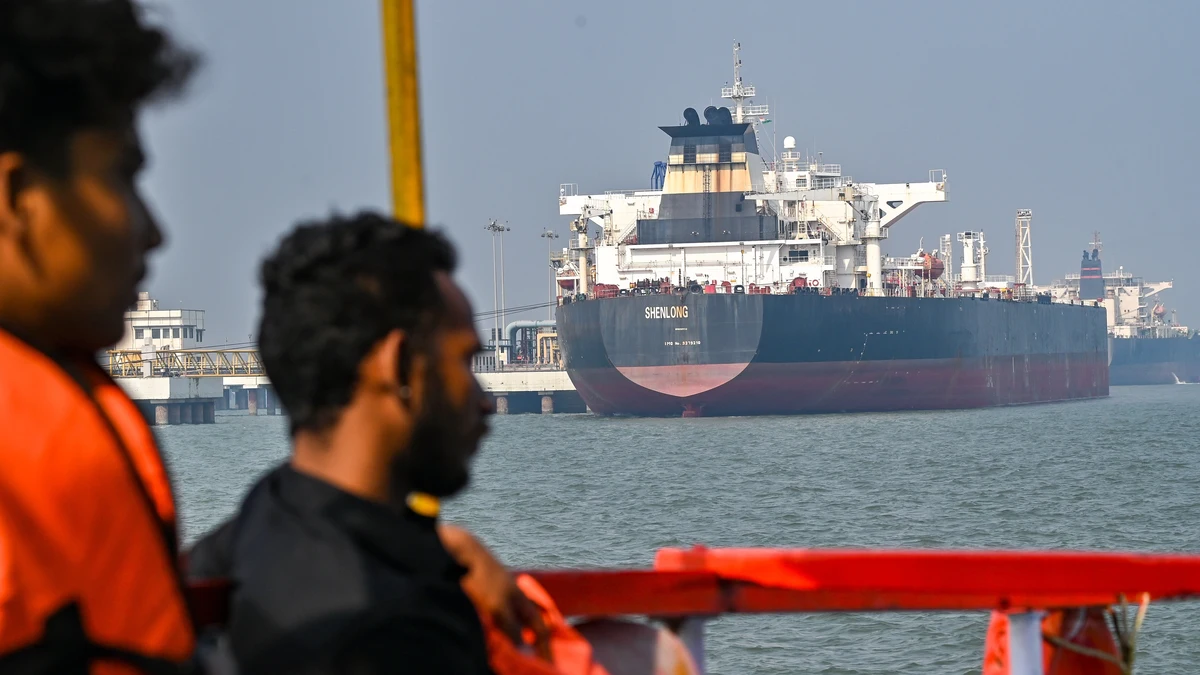
Oil tanker Shenlong Suezmax successfully reached Mumbai carrying Saudi crude after navigating the war-hit Strait of Hormuz amid GPS jamming and electronic blackout during the escalating US-Iran conflict.
A Dangerous Voyage Through a War Zone
In a dramatic journey through one of the world’s most volatile maritime corridors, the oil tanker Shenlong Suezmax successfully reached India after navigating the Strait of Hormuz, a strategic chokepoint now overshadowed by the escalating US-Iran conflict.
The Liberia-flagged tanker, carrying 1,35,335 metric tonnes of crude oil from Saudi Arabia, docked at Mumbai’s Jawahar Dweep terminal on March 11, becoming the first vessel to deliver crude to India through the strait since hostilities erupted on February 28.
The voyage was anything but routine. As the vessel approached the narrow 33-km-wide Strait of Hormuz — a route through which nearly 20% of the world’s crude oil flows — its navigation systems suddenly went dark.
Digital Navigation Collapse in the Gulf
During the transit, the ship encountered severe GPS spoofing and signal jamming, a form of electronic warfare increasingly used in modern conflicts.
According to maritime sources, the tanker’s Automatic Identification System (AIS) and tracking transponders stopped transmitting signals for a significant portion of the journey.
While such “dark sailing” is sometimes used intentionally to avoid detection in hostile waters, in this case the blackout was reportedly caused by persistent electronic interference, making satellite navigation unreliable.
For several hours in the strait, the vessel effectively disappeared from global maritime tracking systems before reappearing a day later.
Navigating Like the Pre-Digital Era
With modern navigation tools compromised, the crew was forced to rely on traditional maritime navigation techniques.
Captain Sukshant Singh Sandhu, an experienced Indian mariner from Mohali, led the vessel through the dangerous waters using manual navigation methods reminiscent of the pre-GPS era.
Second Officer Abhijit Alok said the bridge team switched to secondary navigation tools and relied on the captain’s experience.
“The ship lost GPS signals multiple times. We had to sail the way ships did decades ago — without relying on satellite navigation,” he said.
The 29-member multinational crew, consisting of sailors from India, Pakistan and the Philippines, continued the journey despite the uncertainty.
Crew members also reported seeing fighter jets flying overhead near Saudi airspace, a reminder of the conflict unfolding around them.
Strait of Hormuz: The World’s Most Critical Oil Route
The Strait of Hormuz has now become the epicenter of geopolitical tensions following the US-Israeli strikes on Iran on February 28.
This narrow passage connects the Persian Gulf to the Arabian Sea and remains the most important oil transit chokepoint in the world.
With tensions rising, global energy markets are closely watching developments, particularly because any disruption here could trigger major supply shocks and price volatility.
India, one of the world’s largest oil importers, is already witnessing concerns over LPG and crude supply stability.
Rising Threats to Commercial Shipping
While the Shenlong’s journey ended safely, the risks across the region remain severe.
Indian officials confirmed that three Indian seafarers have died and one is missing following attacks on foreign-flagged vessels in the region.
Recent incidents include:
- Safesea Vishnu, a Marshall Islands-flagged vessel attacked near Iraq
- Mayuree Naree, a Thailand-flagged ship struck near Basra on March 11
India’s Ministry of External Affairs has expressed serious concern over commercial shipping becoming a target in the expanding conflict.
Hundreds of Indian Seafarers Still in the Gulf
According to government data:
- 28 Indian-flagged vessels remain in the Persian Gulf region
- 778 Indian sailors are currently onboard these ships
- 22 vessels have been marked as priority ships for potential naval escort
The Indian government has also established a 24-hour maritime monitoring control room to track ships operating in the region.
After unloading crude at Mumbai’s refineries in Mahul, the Shenlong tanker is scheduled to sail for Fujairah port in the UAE.
However, the risk remains high.
Earlier this week, debris from an intercepted drone caused a fire at the Fujairah port, highlighting how the conflict is expanding beyond the Strait of Hormuz.
Interesting Read
India Prepares for Heavy Vessel Traffic
Meanwhile, Deendayal Port Authority in Kandla, Gujarat, has announced preparations to handle 22 ships in the next 72 hours, many of them carrying crude oil shipments rerouted amid the conflict.
Despite the chaos unfolding across the Gulf, maritime authorities say port systems are functioning smoothly to manage the surge in incoming vessels.
A Voyage of Courage in Uncertain Waters
The successful journey of the Shenlong Suezmax highlights the resilience of seafarers navigating through one of the most dangerous maritime environments in recent years.
In an age dominated by satellite navigation and digital systems, the voyage also proved that traditional seamanship and human judgment remain crucial when technology fails.
As tensions in the Middle East continue to escalate, the Strait of Hormuz remains a high-risk gateway for global energy supplies — and every ship that passes through it now sails under the shadow of war.