
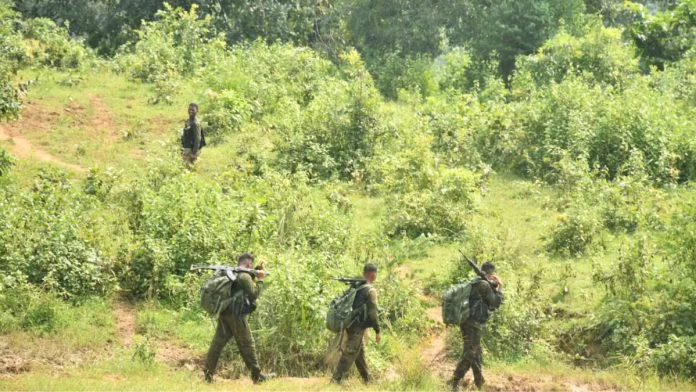
Chhattisgarh Deploys Local Youths at 30 Locations to Protect Abujhmad Forests Amid Crackdown on Illegal Tree Felling
In a significant move aimed at strengthening forest conservation and curbing illegal logging, the Chhattisgarh Forest Department has launched a comprehensive protection initiative across the dense forests of Abujhmad. By deploying local youths at 30 strategically identified locations, establishing new forest infrastructure, and proposing five new forest ranges, the state government is taking proactive steps to safeguard one of India’s largest and least explored forest landscapes.
The initiative marks a shift from reactive enforcement to a long-term conservation strategy that combines community participation, improved administration, and sustainable forest management. Officials believe involving local communities in protecting forests will not only prevent illegal tree felling but also generate employment opportunities while promoting environmental stewardship.
Why Abujhmad Matters
Abujhmad, spread across the districts of Narayanpur, Bijapur, and Dantewada in southern Chhattisgarh, covers nearly 4,000 square kilometres of dense forests. Often referred to as one of India’s last unmapped wilderness regions, the area has remained largely inaccessible for decades due to difficult terrain, lack of infrastructure, and prolonged Maoist insurgency.
Its forests are home to diverse wildlife, rich biodiversity, and indigenous tribal communities who have traditionally depended on forest resources for their livelihood. Despite its ecological significance, much of Abujhmad has remained outside formal administrative records because comprehensive revenue and forest surveys have not been completed.
This lack of official demarcation has created challenges for forest governance, making the region vulnerable to illegal logging, encroachment, and other forest-related crimes.
Immediate Action Against Illegal Tree Felling
According to senior forest officials, reports of increasing illegal tree felling in certain parts of Abujhmad prompted immediate intervention.
Rather than waiting for the completion of the ongoing land survey, the Forest Department decided to establish an active protection network by deploying local youths at 30 critical locations across the forest landscape.
These personnel will act as frontline forest protectors, monitoring suspicious activities, preventing illegal logging, and reporting violations to forest authorities.
Officials stated that temporary tent accommodations have already been arranged to enable round-the-clock monitoring in remote forest locations.
The department believes that having a continuous human presence inside the forests will significantly reduce opportunities for illegal timber extraction while improving surveillance in previously unmonitored areas.
Empowering Local Communities Through Conservation
A unique feature of the initiative is the decision to recruit local tribal youth instead of relying solely on external forest personnel.
The department believes local residents possess invaluable knowledge of the terrain, wildlife movement, forest routes, and seasonal changes that can greatly enhance conservation efforts.
The selected youths will receive at least the prescribed minimum wages and may be engaged as daily wage workers or under specialized forest protection arrangements depending on operational requirements.
Beyond employment generation, officials see this initiative as an opportunity to strengthen trust between government agencies and local communities.
When local people become stakeholders in conservation, forest protection becomes more sustainable and socially inclusive.
Temporary Camps to Become Permanent Infrastructure
Initially, deployed personnel will stay in temporary tents positioned across strategic forest locations.
However, the state government has already sanctioned funds for the construction of five permanent forest guard buildings.
Officials confirmed that additional funding will be sought to build similar infrastructure at all remaining locations in the coming phases.
Permanent camps will provide accommodation, communication facilities, storage spaces, and operational support for forest guards working in challenging conditions throughout the year.
Improved infrastructure is expected to enhance both staff safety and operational efficiency.
Proposal for Five New Forest Ranges
Alongside ground-level deployment, the Forest Department has completed a preliminary survey proposing the creation of five new forest ranges covering approximately 2,550 square kilometres of currently unmapped forests.
The proposal has been forwarded for government notification.
Once approved, these newly designated forest ranges will officially fall under the administrative control of the Forest Department, allowing systematic monitoring, patrolling, conservation planning, and enforcement of forest laws.
The move represents one of the largest administrative expansions of forest management in Chhattisgarh in recent years.
Interesting Reads
Chhattisgarh forest dept deploys locals at 30 locations in Abujhmad: Officials
How Teaching Crisis Could Impact Higher Education, Research and Innovation
Forest Survey to Strengthen Legal Protection
One of the biggest challenges facing conservation efforts in Abujhmad has been the absence of clear legal boundaries.
Revenue surveys are currently underway to formally map land ownership and classifications.
Recognising the importance of coordinated mapping, the Forest Department has requested that its officials be included in the ongoing survey process.
This integrated approach will help simultaneously identify forest boundaries and revenue land, reducing future disputes while ensuring environmentally sensitive areas receive legal protection.
Officials indicated that senior government authorities have already directed departments to accelerate the survey process.
Narayanpur Forest Division Set for Major Expansion
Once the proposed forest ranges receive official approval, the Narayanpur Forest Division is expected to become the largest forest division in Chhattisgarh.
The expansion will significantly increase the department’s capacity to manage vast stretches of forest previously lacking structured oversight.
With dedicated administrative units, authorities expect improved monitoring of biodiversity, enhanced forest fire management, better wildlife protection, and faster responses to illegal activities.
The expanded division will also facilitate improved planning for eco-restoration, afforestation, and community-based conservation programmes.
Balancing Development and Conservation
Abujhmad has witnessed increasing infrastructure development in recent years, including new roads, bridges, communication facilities, and public services aimed at connecting remote tribal regions with the rest of the state.
While improved connectivity supports economic development and public welfare, it also increases pressure on forest resources.
Experts note that expanding infrastructure often creates easier access for illegal timber operators unless accompanied by robust conservation measures.
The current initiative seeks to ensure that development progresses alongside strong environmental safeguards.
Role of Community Participation in Forest Governance
Globally, successful forest conservation increasingly depends on involving local communities rather than relying solely on enforcement agencies.
The Chhattisgarh government’s strategy reflects this evolving approach.
Local tribal communities have traditionally lived in harmony with forests for generations, possessing extensive ecological knowledge about native species, medicinal plants, seasonal changes, and wildlife habitats.
By integrating local residents into formal conservation efforts, authorities hope to create a more resilient and responsive forest management system.
Such participation may also reduce conflicts while encouraging sustainable use of forest resources.
Challenges That Remain
Despite the positive initiative, several challenges continue to exist.
Abujhmad’s dense terrain makes transportation and communication difficult, especially during the monsoon season.
Ensuring adequate food supplies, healthcare access, communication equipment, and safety for deployed personnel will require sustained logistical support.
The success of the programme will also depend on timely construction of permanent infrastructure, regular monitoring, proper training, and continuous funding.
Experts emphasize that conservation efforts must also balance ecological protection with the rights and livelihoods of indigenous communities living within the region.
Environmental Significance of Protecting Abujhmad
Abujhmad represents one of central India’s most ecologically valuable forest ecosystems.
Its forests support countless plant species, mammals, birds, reptiles, and insects while acting as an important carbon sink that helps combat climate change.
Protecting these forests contributes to:
- Biodiversity conservation
- Climate resilience
- Watershed protection
- Soil conservation
- Wildlife habitat preservation
- Sustainable livelihoods for tribal communities
As India works toward its climate commitments and forest conservation goals, safeguarding regions like Abujhmad becomes increasingly important.
A New Direction for Forest Conservation
The Forest Department’s decision to act before the completion of formal surveys demonstrates a proactive approach toward environmental governance.
Instead of delaying intervention until administrative procedures conclude, authorities have prioritised immediate protection against illegal activities while simultaneously preparing long-term institutional structures.
The combination of community participation, expanded administrative coverage, permanent infrastructure, and scientific boundary mapping could serve as a model for protecting other ecologically sensitive regions facing similar challenges.
Conclusion
Chhattisgarh’s decision to deploy local youths across 30 strategic locations in Abujhmad marks an important milestone in India’s forest conservation efforts. By combining community participation with administrative expansion, infrastructure development, and long-term planning, the state aims to strengthen protection of one of the country’s largest and most ecologically significant forest regions.
As the proposed forest ranges receive official approval and permanent facilities become operational, the initiative has the potential to transform forest governance in Abujhmad while protecting biodiversity, supporting tribal livelihoods, and reducing illegal tree felling. If successfully implemented, it could become a model for sustainable forest management across other remote regions of India.