
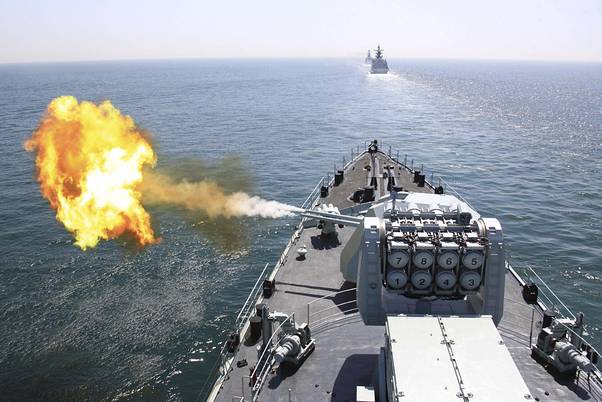
China has once again drawn international attention after successfully launching a strategic missile into the Pacific Ocean on Monday, coinciding with the start of its annual joint naval exercises with Russia. The missile test, carried out by the People’s Liberation Army Navy (PLAN), comes amid growing geopolitical tensions in the Indo-Pacific and renewed concerns over China’s expanding military capabilities.
Although Chinese authorities described the launch as a routine military training exercise conducted with prior notification to relevant countries, the timing of the test and its strategic implications have sparked fresh debate among regional governments, defence experts, and global security analysts.
The latest missile launch underscores China’s increasing focus on strengthening its maritime defence capabilities while reinforcing its strategic partnership with Russia. It also highlights the evolving security landscape in the Pacific, where military activities by major powers are becoming increasingly frequent.
China Confirms Successful Strategic Missile Launch
According to an official statement issued by the People’s Liberation Army Navy, a strategic nuclear submarine successfully launched a strategic missile carrying a simulated training warhead into designated waters of the Pacific Ocean.
Military spokesperson Wang Xuemeng stated that the missile accurately reached its intended target area, emphasizing that the exercise was part of China’s annual military training schedule.
Chinese officials stressed that the launch was not directed at any specific country and that neighbouring governments had been informed beforehand to ensure maritime safety and avoid misunderstandings.
While Beijing did not disclose the exact missile model used during the exercise, analysts believe the test demonstrates the operational readiness of China’s submarine-based strategic deterrent.
Missile Launch Coincides with China-Russia Naval Exercises
The missile test took place on the same day China and Russia commenced their annual joint naval drills near Qingdao, an important naval base located along China’s eastern coastline.
The exercises involve multiple naval vessels, aircraft, and support units from both countries and are designed to enhance interoperability, maritime security cooperation, and joint combat readiness.
Although Chinese officials have not confirmed whether the missile launch formed part of the naval exercises, the simultaneous timing has attracted significant international attention.
The growing defence cooperation between Beijing and Moscow reflects their shared objective of strengthening military ties amid increasing strategic competition with Western nations.
Regional Governments Receive Advance Notice
Before the missile launch, China reportedly notified several countries across the Pacific about the planned military exercise.
Papua New Guinea Foreign Minister Justin Tkatchenko confirmed receiving a direct communication from China’s ambassador regarding the upcoming missile test.
Officials in New Zealand also acknowledged that Beijing had informed their government in advance about an intercontinental ballistic missile-related exercise, although the precise impact zone was not publicly disclosed.
Such advance notifications are generally intended to reduce the risk of accidental military escalation while ensuring civilian maritime and aviation safety.
However, analysts note that even routine notifications cannot entirely eliminate regional concerns regarding the rapid pace of China’s military expansion.
Growing Importance of China’s Submarine Fleet
The latest missile launch places renewed attention on China’s rapidly modernising submarine force, which has become one of the country’s most important strategic assets.
Unlike land-based missile systems, submarine-launched ballistic missiles provide greater survivability because submarines can remain hidden underwater for extended periods.
This capability significantly strengthens China’s second-strike nuclear deterrence, ensuring the country maintains a credible retaliatory capability in the event of a nuclear attack.
Over the past decade, China has invested heavily in developing advanced ballistic missile submarines, improved underwater surveillance systems, and longer-range submarine-launched missiles capable of reaching targets thousands of kilometres away.
China’s Expanding Missile Capabilities
China continues to modernise one of the world’s fastest-growing missile arsenals.
Military analysts believe Beijing has significantly expanded its inventory of:
- Intercontinental Ballistic Missiles (ICBMs)
- Submarine-Launched Ballistic Missiles (SLBMs)
- Hypersonic glide vehicles
- Medium-range precision strike missiles
- Anti-ship ballistic missiles
These weapons are intended to strengthen China’s strategic deterrence while expanding its ability to operate across the Indo-Pacific region.
The People’s Liberation Army has also accelerated investment in space-based surveillance, artificial intelligence, cyber warfare, and integrated command systems to complement its missile forces.
Lessons from the 2024 Pacific Missile Test
Monday’s launch follows another high-profile Chinese missile test conducted in September 2024, when the People’s Liberation Army Rocket Force launched a dummy warhead into international waters near French Polynesia.
That test marked China’s first long-range missile launch over the Pacific Ocean in more than four decades.
Defence experts at the time believed the missile involved was likely the advanced Dong Feng-31 (DF-31), an intercontinental ballistic missile capable of carrying a thermonuclear warhead across thousands of kilometres.
The test generated concern because the missile landed within waters protected under a long-standing South Pacific Nuclear-Free Zone Treaty.
The latest submarine-based launch demonstrates that China continues expanding both land-based and sea-based strategic deterrence capabilities.
Interesting Reads
China successfully test-fires missile into Pacific Ocean as joint naval drills with Russia begin
Chhattisgarh Deploys Local Youth at 30 Locations to Protect Abujhmad Forests
Rising Security Concerns Across the Indo-Pacific
China’s expanding military footprint has become one of the defining security issues across the Indo-Pacific region.
Countries including Japan, Australia, India, New Zealand, South Korea, and several Southeast Asian nations have closely monitored Beijing’s increasing naval deployments, military exercises, and missile tests.
Security experts argue that China’s military modernization reflects its ambition to project greater influence across strategically important sea lanes connecting the Pacific and Indian Oceans.
Several regional governments have simultaneously strengthened defence partnerships through initiatives such as:
- The Quad (India, United States, Japan, Australia)
- AUKUS security partnership
- Expanded ASEAN maritime cooperation
- Bilateral defence agreements across the Indo-Pacific
These developments illustrate the growing strategic competition shaping the region.
China-Russia Defence Partnership Continues to Deepen
Military cooperation between China and Russia has steadily expanded over recent years.
Their joint exercises now include naval operations, strategic bomber patrols, missile defence drills, cyber cooperation, and intelligence sharing.
Although both governments insist the partnership is not directed against any third country, Western governments increasingly view these exercises as demonstrations of strategic alignment.
For Beijing, closer defence ties with Moscow provide valuable operational experience while reinforcing a united front amid growing geopolitical tensions.
International Response Likely to Intensify
Defence analysts believe the latest missile test will likely attract close attention from governments across Asia, Europe, and North America.
While advance notification helped avoid immediate diplomatic confrontation, repeated demonstrations of long-range missile capability may encourage neighbouring countries to accelerate investments in missile defence systems, maritime surveillance, and regional security partnerships.
International observers also expect intelligence agencies to carefully analyse data collected during the launch to better understand China’s evolving submarine and missile technologies.
What This Means for Global Strategic Stability
China’s latest missile launch reflects broader changes taking place in global military competition.
As technological advancements reshape warfare, countries are investing heavily in strategic deterrence, hypersonic weapons, cyber capabilities, artificial intelligence, and underwater military platforms.
The increasing frequency of missile tests and multinational military exercises suggests that strategic competition among major powers is likely to remain a defining feature of international security over the coming decade.
While Beijing maintains that its military modernization is defensive in nature, neighbouring countries continue to view these developments through the lens of regional security and geopolitical balance.
Conclusion
China’s successful strategic missile launch into the Pacific Ocean, conducted alongside the beginning of joint naval drills with Russia, marks another significant milestone in Beijing’s ongoing military modernization programme.
Although Chinese authorities describe the exercise as routine and emphasize that neighbouring countries received advance notification, the test reinforces concerns about the growing militarisation of the Indo-Pacific region and the intensifying strategic rivalry among global powers.
As China continues expanding its missile capabilities, submarine fleet, and international military partnerships, regional governments are expected to strengthen defence preparedness while balancing diplomacy with national security interests. The latest developments serve as another reminder that the Indo-Pacific remains at the centre of evolving global geopolitical competition.