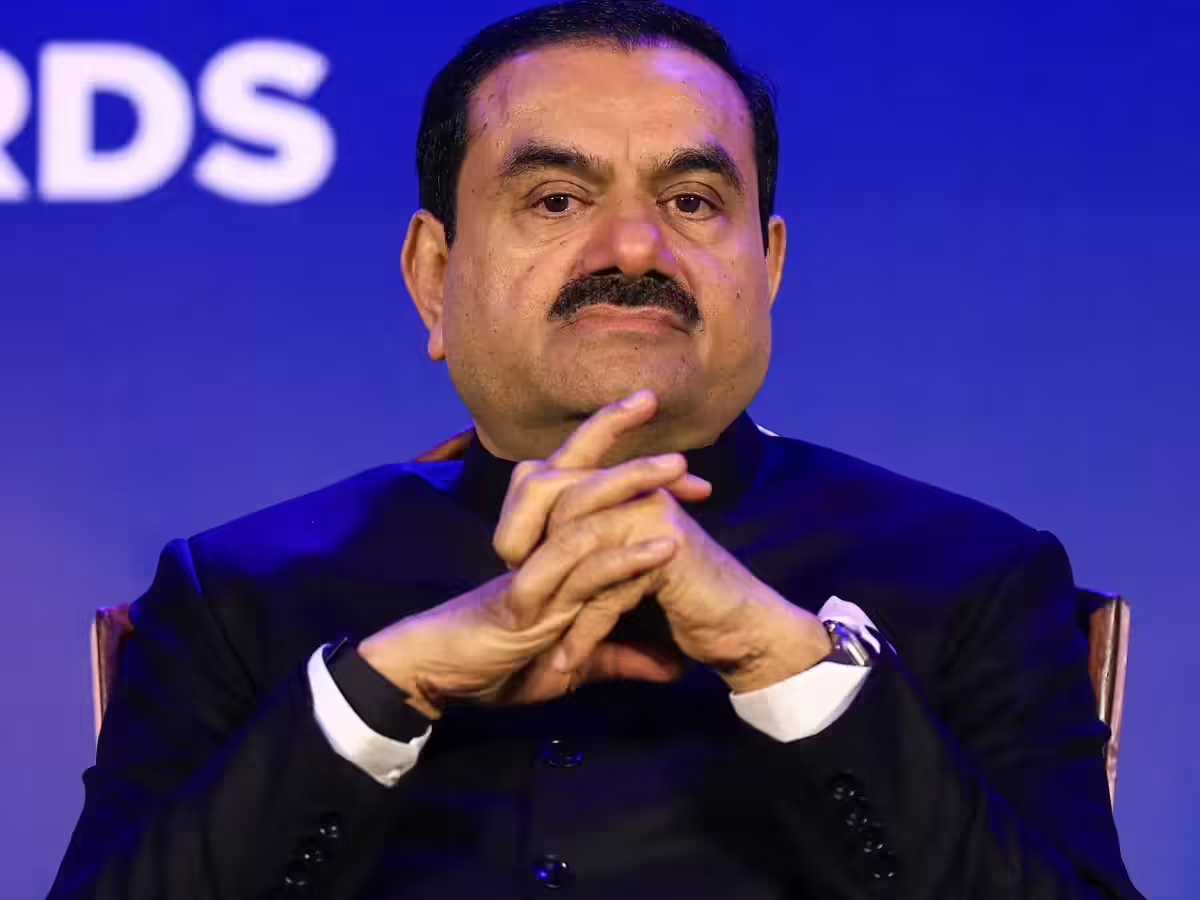
India’s real estate industry witnessed a significant shift in 2026 as Gautam Adani and his family secured the top position in the GROHE-Hurun India Real Estate Rich List 2026, overtaking long-time industry leader Rajiv Singh of DLF. The latest rankings reflect changing market dynamics, strategic investments, and the growing influence of diversified business groups in India’s property sector.
Despite a challenging year marked by slowing market growth, declining real estate stocks, and cautious investor sentiment, Adani Properties emerged as the country’s largest wealth creator in the sector. The report also highlights important trends shaping India’s real estate landscape—from residential housing demand and commercial expansion to regional growth patterns and debt reduction strategies.
Here’s a detailed analysis of what the 2026 rankings reveal about India’s evolving real estate ecosystem.
Gautam Adani Becomes India’s Richest Real Estate Entrepreneur
According to the GROHE-Hurun India Real Estate Rich List 2026, Gautam Adani and family now possess an estimated real estate wealth of ₹90,400 crore, registering a remarkable 73% increase compared to the previous year.
The substantial jump enabled Adani to surpass DLF Chairman Rajiv Singh, whose real estate wealth declined to ₹90,200 crore, largely due to the correction in listed real estate stocks.
While the difference between the top two positions is only ₹200 crore, the ranking symbolizes an important shift in India’s property sector, where infrastructure-driven conglomerates are increasingly competing with traditional real estate developers.
The report notes that Adani Properties, headquartered in Ahmedabad, continues to remain India’s most valuable unlisted real estate company, with several large-scale township, commercial, mixed-use, and infrastructure-linked projects currently under development across the country.
Top 10 Richest Real Estate Leaders in India 2026
The report ranks India’s wealthiest real estate entrepreneurs based on their estimated real estate wealth.
1. Gautam Adani & Family – Adani Properties
- Wealth: ₹90,400 crore
- Growth: +73%
- Headquarters: Ahmedabad
2. Rajiv Singh & Family – DLF
- Wealth: ₹90,200 crore
- Growth: -29%
- Headquarters: New Delhi
3. Mangal Prabhat Lodha & Family – Lodha Developers
- Wealth: ₹67,700 crore
- Growth: -27%
- Headquarters: Mumbai
4. Vikas Oberoi – Oberoi Realty
- Wealth: ₹42,500 crore
5. Chandru Raheja & Family
- Wealth: ₹42,500 crore
6. Atul Ruia & Family – Phoenix Mills
- Wealth: ₹29,900 crore
7. Raja Bagmane & Family – Bagmane Developers
- Wealth: ₹29,100 crore
8. Niranjan Hiranandani – Hiranandani Communities
- Wealth: ₹26,900 crore
9. Basant Bansal & Family – M3M India
- Wealth: ₹25,500 crore
10. Bijay Kumar Agarwal & Family – Sattva Developers
- Wealth: ₹20,500 crore
How Gautam Adani Overtook DLF
The rise of Adani Properties has been driven by aggressive expansion across multiple real estate segments.
Unlike conventional developers focused primarily on residential projects, Adani has leveraged synergies across:
- Integrated townships
- Commercial office spaces
- Smart cities
- Data centres
- Logistics parks
- Industrial corridors
- Mixed-use developments
- Airport-linked urban infrastructure
This diversified strategy has helped the company maintain strong valuation growth despite broader weakness in the property market.
Over the last two years, Adani Properties added nearly ₹33,900 crore in valuation, making it India’s biggest real estate value creator.
DLF Remains India’s Most Valuable Listed Real Estate Company
Although Rajiv Singh slipped to the second position in terms of personal real estate wealth, DLF continues to dominate the industry.
The report states that DLF remains India’s most valuable real estate company, with an enterprise value of approximately ₹1.47 lakh crore.
DLF also continues to lead India in terms of developed area.
Top Developers by Developed Area
- DLF – 352 million sq. ft
- Godrej Properties – 243 million sq. ft
- Prestige Estates – 208 million sq. ft
- Sobha – 153 million sq. ft
- BL Kashyap & Sons – 140 million sq. ft
- Lodha Developers – 112 million sq. ft
The company’s extensive residential, commercial, and retail portfolio ensures it remains one of India’s strongest property brands despite the decline in promoter wealth.
Why Did Real Estate Wealth Slow Down in 2026?
One of the biggest findings of the GROHE-Hurun report is the noticeable slowdown across India’s real estate sector.
The cumulative value of 151 ranked companies increased by only 2% year-on-year, reaching ₹16.5 lakh crore.
This marks the weakest annual growth since the list was first introduced.
For comparison:
- 2025 Growth: 14%
- 2026 Growth: 2%
Several factors contributed to this slowdown.
Correction in Realty Stocks
The BSE Realty Index declined nearly 20%, significantly impacting listed developers’ valuations.
Higher Interest Rates
Rising borrowing costs affected both developers and homebuyers.
Expensive Property Prices
Premium housing prices reached record highs across major cities, slowing fresh demand.
Global Economic Uncertainty
International market volatility affected investment sentiment.
Increased Construction Costs
Developers faced higher costs due to inflation in cement, steel, labour, and logistics.
Interesting Reads
Gautam Adani and family top GROHE-Hurun India Real Estate Rich List 2026, overtake DLF’s Rajiv Singh
Isha Ambani Stuns in Handcraft Gold Couture at Manish Malhotra’s Historic Paris Week
Regional Leaders in India’s Real Estate Industry
The report highlights significant regional concentration.
Western India
Total Value:
₹8.84 lakh crore
Share:
54%
Key Companies:
- Lodha Developers
- Indian Hotels Company
- Adani Properties
Northern India
Total Value:
₹4.49 lakh crore
Share:
27%
Major Players:
- DLF
- Prism (OYO)
- ITC Hotels
Southern India
Total Value:
₹3 lakh crore
Share:
18%
Leading Companies:
- Prestige Estates
- Embassy Office Parks REIT
- Bagmane Prime Office REIT
Eastern India
Total Value:
₹14,000 crore
Share:
1%
Companies include:
- Ambuja Neotia
- PS Group
- Merlin Projects
- Apeejay Surrendra Park Hotels
Mumbai Continues to Dominate
Mumbai retained its status as India’s real estate capital.
The city alone houses 50 companies featured in the ranking, with a combined valuation exceeding ₹7.32 lakh crore.
It is followed by:
- New Delhi – 19 companies
- Gurugram – 18 companies
- Bengaluru – 18 companies
Interestingly, five of India’s top ten richest real estate entrepreneurs are based in Mumbai, reaffirming the city’s leadership in luxury housing, commercial development, and mixed-use projects.
Residential Housing Continues to Lead
Residential development remains the largest segment of India’s property industry.
Sector-wise distribution:
- Residential: 65%
- Hospitality: 16%
- Commercial: 13%
- Others: Remaining share
The report indicates that demand for premium housing remains relatively strong despite moderation in overall market growth.
Emerging Cities Gain Momentum
The 2026 ranking also highlights increasing participation from smaller cities.
Eight non-metro cities now feature companies in the Real Estate 150 rankings.
Among them:
- Kochi
- Lucknow
- Surat
- Indore
- Jaipur
- Coimbatore
Lucknow entered the rankings for the first time through Shalimar Corp, signalling growing investment beyond India’s metropolitan markets.
Biggest Value Creators Since 2024
The report identifies companies that created the highest shareholder value over the past two years.
Adani Properties
Value Created:
₹33,900 crore
Bagmane Prime Office REIT
Value Created:
₹15,200 crore
M3M India
Value Created:
₹14,200 crore
Indian Hotels Company
Value Created:
₹14,100 crore
Phoenix Mills
Value Created:
₹7,600 crore
These companies benefited from strong execution, premium assets, commercial leasing, and hospitality recovery.
Companies Reducing Debt
Financial discipline also emerged as a defining theme.
Top debt reducers included:
- Brookfield India REIT
- M3M India
- Shree Naman Group
- Tata Realty
- SD Corp
Lower debt positions strengthen developers’ balance sheets and improve resilience during market slowdowns.
What the Rankings Mean for Investors
The 2026 rankings suggest that India’s property sector is entering a more mature phase.
Instead of rapid valuation growth across the board, investors are rewarding companies with:
- Strong balance sheets
- Diversified portfolios
- Consistent project execution
- Long-term land banks
- Sustainable revenue streams
- Commercial asset ownership
- Integrated township development
Large developers with multiple revenue sources are increasingly outperforming firms dependent on a single segment.
Future Outlook for India’s Real Estate Market
Despite slower valuation growth, experts remain optimistic about India’s long-term property outlook.
Several structural drivers continue to support the sector:
- Rapid urbanisation
- Rising disposable incomes
- Government infrastructure spending
- Industrial corridor development
- Smart city initiatives
- Growing demand for premium housing
- Expansion of REITs
- Increased institutional investment
Developers are also focusing on technology-driven construction, green buildings, and integrated urban developments to meet evolving consumer expectations.
If interest rates stabilise and housing demand strengthens further, the sector could witness renewed momentum over the next few years.
Conclusion
The GROHE-Hurun India Real Estate Rich List 2026 marks a significant turning point for India’s real estate industry. Gautam Adani’s rise to the top reflects the growing importance of diversified infrastructure-led real estate development, while DLF’s continued dominance as the country’s most valuable property company underscores the strength of established developers.
Although the sector experienced its slowest growth since the rankings began, the report reveals an industry that is becoming more resilient, financially disciplined, and geographically diverse. Residential housing continues to drive the market, while commercial assets, hospitality, and mixed-use developments are creating new opportunities for growth.
As India continues its rapid urban transformation, competition among leading developers is expected to intensify, making innovation, execution, and financial stability the defining factors for future success. The 2026 rankings not only celebrate the country’s wealthiest real estate entrepreneurs but also provide a snapshot of an industry adapting to changing economic realities while preparing for its next phase of expansion.