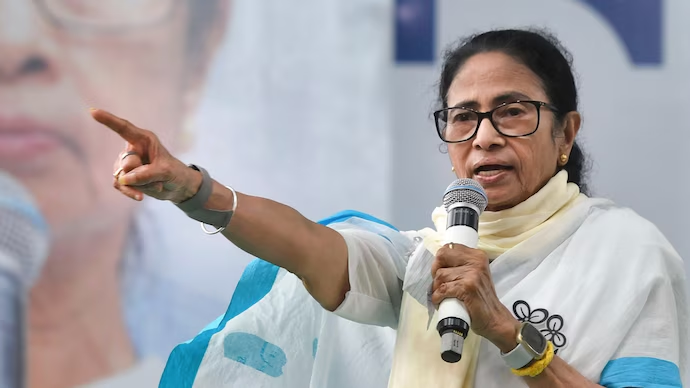
West Bengal Chief Minister and Trinamool Congress (TMC) supremo Mamata Banerjee has delivered one of her strongest political messages in recent years, accusing the Bharatiya Janata Party (BJP) of attempting to destroy her party through intimidation, legal action, and political pressure. In a video statement released on Friday, Banerjee declared that the BJP would have to “kill” her if it wanted to silence her or eliminate the Trinamool Congress, a remark that has intensified the already heated political atmosphere in West Bengal.
The statement comes at a time when the Trinamool Congress is battling one of its biggest internal crises since assuming power in the state in 2011. Reports of a growing rebellion within the party, alleged defections by legislators, and mounting political confrontations with the BJP have created uncertainty over the party’s future strategy.
Banerjee’s address sought to project confidence, reassure party workers, and counter what she described as a coordinated effort to weaken the TMC ahead of future political battles.
Mamata Banerjee Breaks Silence Amid Political Turmoil
After maintaining relative silence over the recent political developments, Mamata Banerjee used a video message to directly address both her supporters and political opponents.
The TMC chief accused the BJP of using every possible means to intimidate her party leaders and workers. She claimed that despite sustained pressure, neither she nor her party would surrender.
“To silence me, you would have to kill me. Yes, you didn’t spare any effort on that,” Banerjee said.
The emotionally charged statement immediately drew nationwide attention, with political observers interpreting it as both a message of defiance and an attempt to rally party workers during a difficult period.
Banerjee has long portrayed herself as a leader who stands firmly against political pressure, and her latest remarks reinforce that image.
TMC Faces Its Biggest Internal Challenge
Banerjee’s statement comes against the backdrop of an unprecedented internal crisis within the Trinamool Congress.
According to political reports, a dissident faction led by senior leader Ritabrata Banerjee has claimed support from nearly 60 Members of the Legislative Assembly (MLAs), raising concerns over internal unity within the party.
Adding to the challenge, reports suggest that at least 20 rebel MLAs have merged with the Tripura-based National Congress of Progressive India (NCPI), a relatively lesser-known political party.
Although the exact numbers remain disputed and the TMC leadership has not officially confirmed the scale of the rebellion, the reports have fueled speculation about growing dissatisfaction among certain sections of the party.
Political analysts believe Banerjee’s video message was carefully timed to send a strong signal to both dissident leaders and party loyalists that the leadership remains united and determined to fight.
BJP Accused of Targeting TMC Leaders
One of the central themes of Banerjee’s address was her allegation that the BJP has systematically targeted senior Trinamool Congress leaders through investigations, political attacks, and public campaigns.
She named several prominent TMC figures, including Mahua Moitra, Abhishek Banerjee, and Kalyan Banerjee, alleging that all had faced repeated political harassment.
“Whom haven’t you assaulted? You attacked Mahua, Abhishek, Kalyan. You attacked my home,” she said.
Although Banerjee did not cite specific incidents in her speech, her remarks reflect the increasingly confrontational relationship between the BJP and TMC over the past several years.
The BJP has consistently denied allegations of political vendetta, maintaining that investigations involving opposition leaders are conducted independently by constitutional agencies.
Allegations of Custodial Harassment
Banerjee also alleged that several TMC leaders and workers have been subjected to degrading treatment while in custody.
According to her, many party workers have been forced to sleep on bare floors in police lock-ups and have experienced humiliation during detention.
She claimed that some leaders were allegedly paraded with ropes tied around their waists, placed in shackles, had their heads shaved, or had objectionable substances thrown at them.
“Many of my colleagues are languishing in lock-ups, forced to sleep on the bare floor. Some are being paraded with ropes around their waists and shackles on their legs; some have had their heads shaved; others have had vile substances thrown at them. It is shameful even to mention it,” Banerjee said.
These allegations have not been independently verified, and there has been no official response from law enforcement agencies regarding the claims.
Nevertheless, the remarks have intensified political debate over the treatment of opposition leaders during investigations.
Political Fight Beyond Elections
Throughout her address, Banerjee attempted to frame the ongoing political conflict as a larger battle for democracy rather than merely an electoral contest.
She argued that political opposition should never become a reason for intimidation or harassment.
According to Banerjee, despite continuous political pressure, the Trinamool Congress remains committed to defending democratic values and protecting the interests of the people of West Bengal.
She assured party workers that the TMC would continue its struggle regardless of political challenges.
Political commentators believe the message was intended to boost morale within the party at a time when reports of defections have generated uncertainty among grassroots workers.
Mid-Day Meal Row Enters Political Debate
Apart from addressing the internal crisis, Banerjee also criticized the BJP over a reported pilot project replacing eggs with vegetarian alternatives in mid-day meals served at selected government schools.
She questioned the government’s priorities, arguing that children require proper nutrition rather than politically motivated policy decisions.
“Children do not get eggs in their mid-day meals. Yet you are busy with such grotesque antics. This was never the culture of Bengal,” she said.
Banerjee has consistently defended nutritional schemes in government schools, arguing that they play a crucial role in improving child health and reducing school dropout rates.
Her remarks are expected to resonate among sections of voters who consider welfare programmes a key achievement of the TMC government.
Concern for Mid-Day Meal Workers
The Chief Minister also highlighted the condition of workers associated with the state’s mid-day meal programme.
She claimed that cooks and helpers working under the scheme continue to face financial hardships despite playing an essential role in the education system.
According to Banerjee, these frontline workers deserve better wages, improved working conditions, and greater government support.
The issue has become another point of political contest between the TMC and BJP, with both parties accusing each other of neglecting welfare initiatives.
Political Context Behind the Escalation
Relations between the BJP and the Trinamool Congress have steadily deteriorated over the past decade.
Since the BJP emerged as the principal opposition force in West Bengal, political competition has intensified considerably.
The rivalry became particularly visible during the 2019 Lok Sabha elections and the 2021 West Bengal Assembly elections, where the BJP mounted an aggressive campaign against the ruling TMC.
Although the Trinamool Congress retained power in 2021 with a convincing mandate, political tensions have remained high.
Since then, both parties have frequently accused each other of corruption, misuse of investigative agencies, political violence, and attempts to suppress democratic institutions.
The latest exchange reflects the continuing polarization of West Bengal politics.
Interesting Reads
‘To silence me, you’d have to kill me’: Mamata releases video message for BJP amid TMC crisis
Karnataka’s Leadership Crisis? Bommai’s Big Claim Sparks Fresh CM Change Talks
Why the Internal Rebellion Matters
The reported rebellion within the Trinamool Congress could have significant political implications.
If the reports regarding support for dissident leaders prove accurate, the party leadership may have to devote considerable attention to restoring internal unity before future elections.
Political observers believe internal divisions can weaken organizational strength, particularly in a state where elections are highly competitive.
Banerjee’s strong public statement may therefore be viewed as an effort to consolidate support among party legislators, district leaders, and grassroots workers.
Her emphasis on resilience also signals that the TMC leadership intends to project stability despite ongoing challenges.
Opposition Politics in West Bengal
West Bengal remains one of India’s most politically vibrant states.
The contest between the BJP and the TMC has transformed the state’s political landscape over the last decade.
While the BJP has steadily expanded its organizational presence, the Trinamool Congress continues to dominate state politics through its extensive grassroots network and welfare programmes.
Political analysts note that future elections are likely to witness even more aggressive campaigning, with issues such as governance, employment, corruption, welfare schemes, and federal relations dominating public discourse.
The current political confrontation is therefore being viewed as an early indicator of larger battles to come.
Public and Political Reactions
Banerjee’s remarks quickly generated reactions across social media and political circles.
Supporters praised her speech as an example of fearless leadership and resistance against political intimidation.
Opposition leaders, however, accused her of making emotionally charged statements to divert attention from the internal problems facing the Trinamool Congress.
Some political commentators argued that the speech was intended primarily for party workers rather than the general public.
Others suggested that the video was designed to reinforce Banerjee’s image as a resilient leader capable of confronting political adversity.
BJP Yet to Issue Detailed Response
At the time of writing, the Bharatiya Janata Party had not issued a detailed official response addressing Banerjee’s specific allegations.
Similarly, no official confirmation has been provided regarding her claims about the alleged treatment of TMC leaders in custody.
Political observers expect both parties to continue exchanging sharp statements as the political situation develops.
Looking Ahead
With reports of internal dissent, allegations of political targeting, and an increasingly polarized political environment, West Bengal appears set for another period of intense political activity.
For Mamata Banerjee, maintaining unity within the Trinamool Congress while countering the BJP’s growing political influence will remain a key challenge in the coming months.
Her latest statement demonstrates that she intends to adopt an aggressive political approach rather than a defensive one.
Whether the speech succeeds in uniting party workers and containing internal rebellion remains to be seen, but it has undoubtedly reignited political debate across the state.
As West Bengal moves closer to future electoral contests, the confrontation between the TMC and BJP is expected to become even more intense, with governance, welfare, political accountability, and democratic institutions remaining at the center of public discussion.